Writing your own vows (without needing a wee lie down)
Is there anything more likely to send a happily engaged person off to clean the oven than the words write your own vows?
I understand the panic. A blank page can feel like a cliff edge, and the minute you sit down to start writing your own wedding vows, every English teacher you ever had seems to join your mother-in-law-to-be in the queue behind your chair. Then there's the pressure of saying it all out loud, in front of your partner, your pals, and your Great Auntie Morag, who cries at adverts.
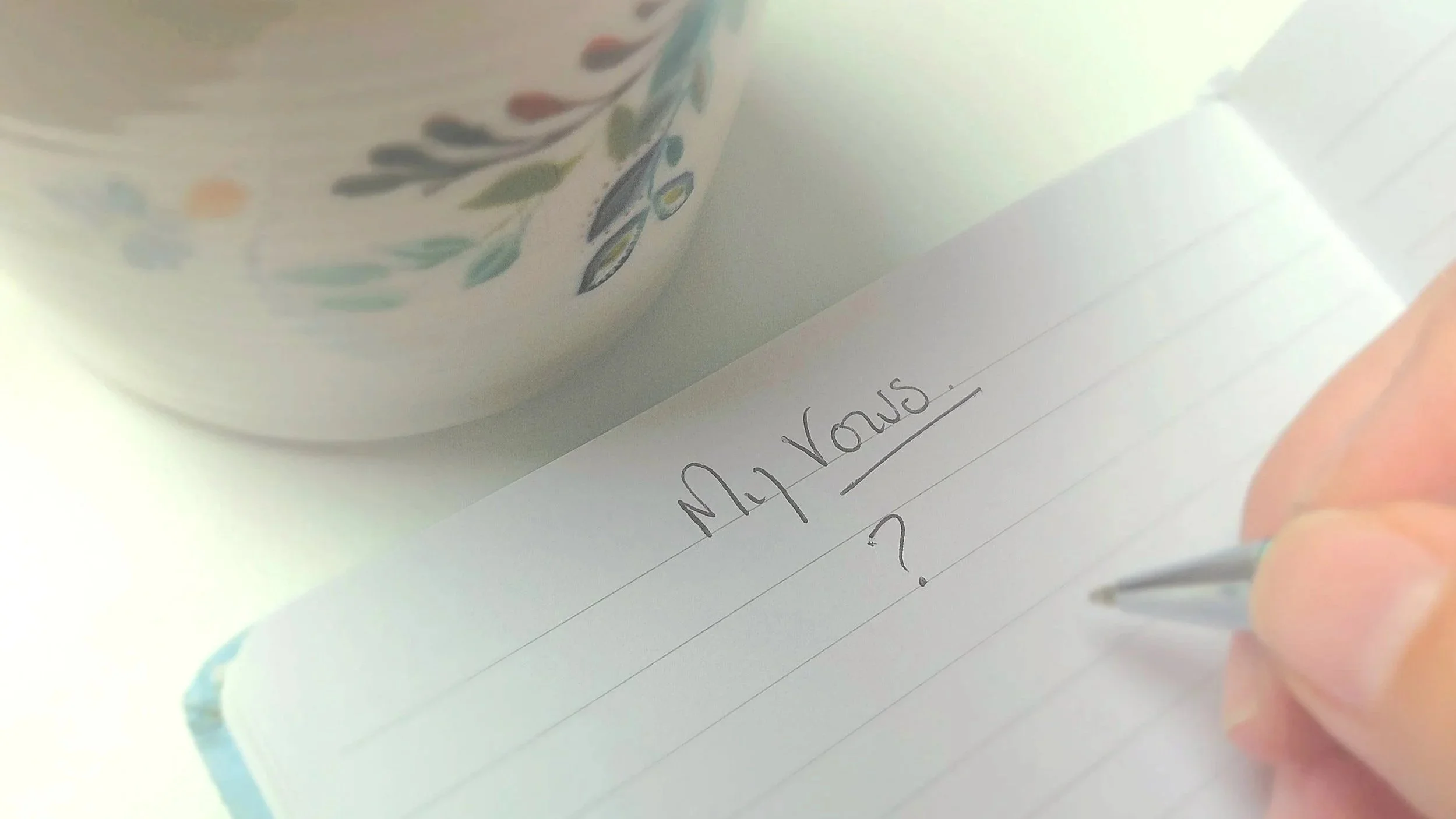
So before you pick up a pen, let me take some of that weight off your shoulders. Knowing how to write wedding vows isn't about being a poet. Your vows don't need to rhyme, quote Shakespeare or be the longest thing anyone's heard since the minister's sermon at your cousin's christening.
They need to come from the heart. And they need to be true.
So, what actually is a vow?
A vow is a promise. Not a wish, not a hope, and not just a lovely memory of how your eyes first met across a crowded chip shop (charming as that is). A promise.
It's you, standing in front of the person you love and the people who love you both, saying: this is what I will do for you. This is how I'll show up for you. Today, tomorrow, and for ever.
That last part is the bit that counts. A vow isn't a snapshot of how you feel on your wedding day, when you're scrubbed up, a wee bit giddy and running on adrenaline and sugared almonds. It's something you carry with you into the ordinary days... the Tuesday nights, the bin days, the rough patches that never make it onto anybody's Instagram.
If you're having a legal ceremony, your celebrant will look after the legal declarations that make the marriage official. Your personal vows sit alongside those, and they're the part that belongs entirely to the two of you.
Say what they mean to you (if you want to)
Some couples like to say why they're making these promises before they do. What they love about their person. What that person's brought to their life. Who they get to be when they're with them. It's not a promise as such, but it's the ground the promises stand on. Think of it as the "because" that comes before the "I promise." You make me braver than I manage on my own, so I promise to...
And if that's not your style, don't do it. Some people would rather get straight to the promises, and there's nothing missing from vows that do exactly that. Go with whatever sounds like you, not whatever you think is expected.
Either way, your vows are the one moment in the whole day when the two of you speak to each other. That makes them sacred, and sacred doesn't need a loudspeaker. If your voice drops so low that only your partner catches it, so be it. Great Auntie Morag will cope. As long as they hear you and you mean every word, your vows have done their job. If you'd like to keep them that intimate, tell me, and I’ll make it work on the day.
There's no point in promising what you won’t do
A vow you don't mean isn't a vow. It's a nice line.
Anyone who's read my blog about the third weekend of my Rites and Rituals training will know how I feel about this. When two people make promises to each other in front of witnesses, they're standing on sacred ground, and that's what turns a wedding from an event into a ceremony. Your vows are the beating heart of that, the threshold moment, and they deserve to be honest.
So if you've never once in your life voluntarily got up for a 6am run, please don't promise to join your other half on theirs. Promise to have the kettle on when they get back instead. One is a fib made up for the occasion, and the other is love you'll deliver on a wet Wednesday in February.
A good test is to read each promise aloud and ask yourself: will I still be doing this in twenty years? If the honest answer is a wobbly maybe, rewrite it until it's a yes.
Funny is allowed. So is serious.
Some vows have the whole room laughing. Some have everyone rummaging for a hanky. The best ones often manage both within a minute, and there's nothing wrong with that.
Humour works beautifully when it's rooted in who you are as a couple. Something like:
"I promise to let you have the last roast potato, even when I really, really want it."
A more reverential vow might sound like:
"I promise to be your safe place, during your happy days, and the days you’re sad."
And sometimes one line does a bit of both:
"I promise to love you through every season of our lives, including the one where you decide to grow a beard."
If laughter's your thing, let the humour and the heart sit side by side. Vows that are all jokes can leave your partner wondering which bits you meant. Vows with a laugh and a lump in the throat leave nobody in any doubt.
How to write wedding vows when you don't know where to start
Start by forgetting about vows altogether for ten minutes. Grab a cuppa and a notebook and jot down the things your partner does that you'd miss terribly if they stopped. The way they warm the car on frosty mornings. How they listen properly when you've had a rotten day. The fact they remember your mum's birthday before you do.
Now turn those into promises. If they always make you laugh, promise to keep laughing with them. If they've held you up through something hard, promise you'll do the same for them. Before long, you'll have far more than you need.
Use the words “I promise” and “I will” because they point forward. Write the way you talk, too. If you'd never say "thee" over your cornflakes, don’t say it in your vows. Then read it out loud, because words that sound good in your head can trip you up on the day.
You can keep them fairly short, if that’s better. A minute or so is plenty, and it's kinder to your nerves. And have a chat with your partner beforehand about roughly how long and what tone you're both aiming for, even if you keep the actual words a surprise. Nobody wants to deliver a heartfelt two-page sonnet straight after "I promise to always share my chips."
Say it like you mean it (notes very much allowed)
During my training, I was once told to put my carefully prepared notes to one side just before I stood up to speak. I've still not entirely recovered.
But your wedding isn't a training exercise, and nobody's confiscating anything. Write your vows on a nice card, hold onto it, and read from it. Look up at your partner when you can. Take a breath between promises. Nobody's marking you on delivery.
And if your voice cracks halfway through? Good. It means the words are landing exactly where they should.
If you get stuck, that's what your marriage celebrant is there for. I'm always happy to have a chat, look over a draft, or help you find the words you're looking for, without putting mine in your mouth. They should sound like you, after all.
And while we're at it, please don't ask a chatbot to write them for you. It's never had you steal its chips, it wasn't there the night you both got lost looking for that wee café in Oban, and it's certainly never fallen in love with you. Your partner will know the difference between words from your heart and words from a search bar. So will Great Auntie Morag.
The promise is the point
Your vows don't have to be perfect. They don't have to be clever, and they certainly don't have to impress anyone but the person standing opposite you. They need to be yours, they need to be true, and you need to be ready to keep them long after the last of the confetti's been hoovered out of the car.
So put the oven gloves down, put the kettle on, and grab your notebook.
The oven's waited this long. It can wait a wee bit longer.