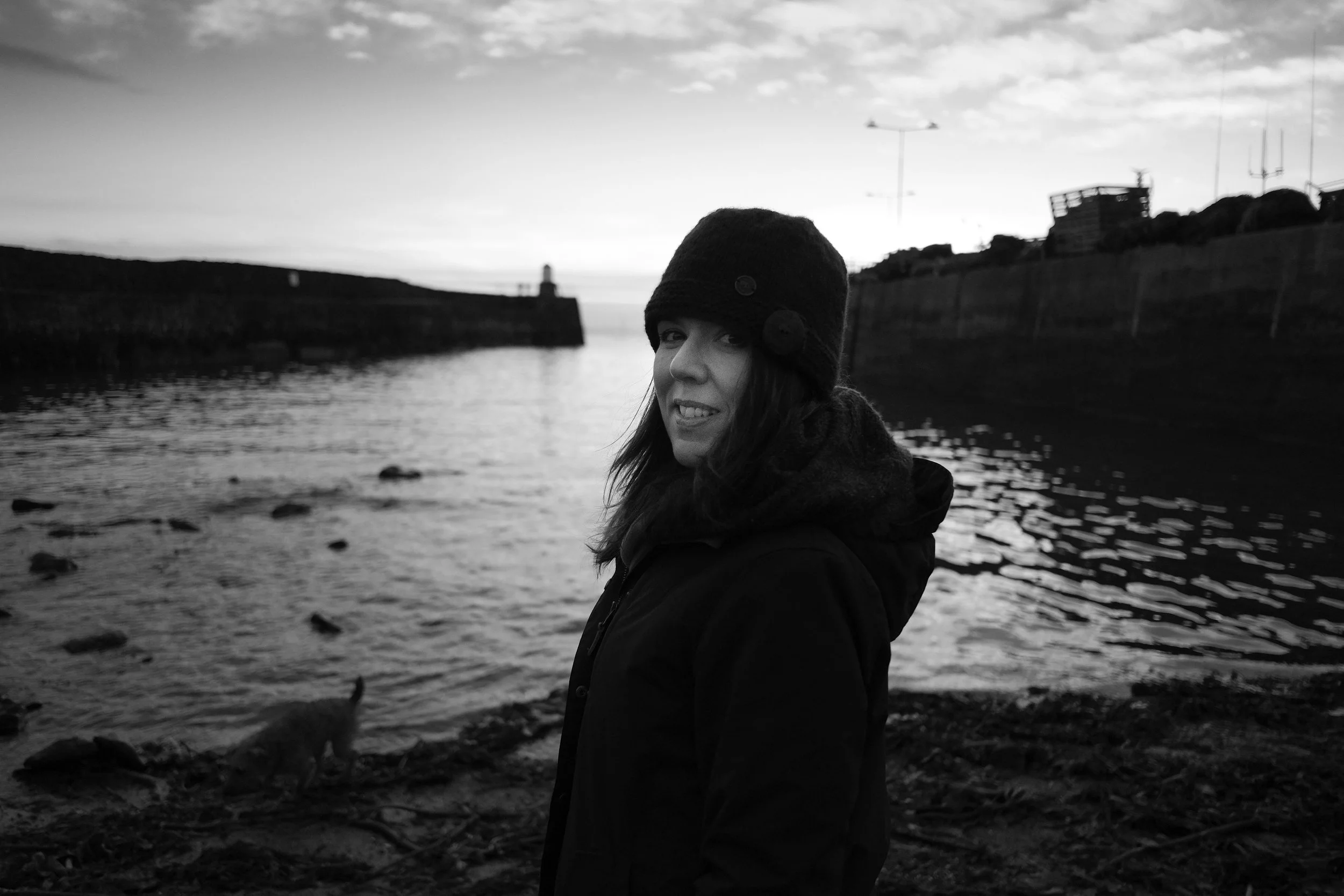
Funeral Celebrant in Scotland
If someone you love has died, I’m sorry.
I write and lead funeral services across Scotland, at crematoria, at gravesides, and at memorials held months or years later. Whatever you're carrying at the moment, the words don't have to be part of it. That's my job.
You don't need to have this worked out
Most people come to me with a date, a funeral director's phone number and no real idea what they want.
That's normal.
Nobody's supposed to be good at this.
You don't need to have chosen music or readings, or worked out who's speaking.
Bring what you've got, even if what you've got is that she was your mum and you can't take it in yet. We'll take it from there.
What happens from the first call to the day of the funeral
-
Your funeral director will arrange it, and plenty of families don't realise that's their choice to make. Just as often it happens the other way round, and your funeral director passes me your number. Either way, the first thing we do is talk.
-
Ten minutes, no more. Whether you've rung me or I'm ringing you, I'll ask what's happened, and where and when the service is. If I'm not free that day, I'll tell you straight away rather than leave you waiting. And if I'm not the right person for your family, I'll say so and point you to someone who is.
-
Usually at home, on the sofa or around your kitchen table, with whoever wants to be there. Two hours, sometimes three. This is where the service actually comes from.
If you're a long way from Glasgow, we'll do it on a video call instead. It's not the same as being in the room with you, but it's not a lesser version of the meeting either. I ask the same questions and I take the same time over it.
-
Everything: the welcome, the tribute, the committal, the closing words. Or as much of it as you want me to, because some families want to write a part of it themselves and that's welcome. If someone wants to speak, I'll help them get their words down, and I'll be ready to read it for them if they can't get through it on the day.

The family meeting
This is the part that really matters
It isn't an interview. It's a couple of hours of talking about someone you love, and some families find it's the first time since the death that they've laughed. I'll ask the usual things: where he was born, who he married, what he did. But those aren't the questions that make a service sound like a person. Some of it won't make it into the service. All of it helps me understand who I'm writing about.
Who did she phone first when something happened?
What's the thing nobody wants to mention that shouldn't be left out?
If he could see us organising all this, what would he be saying?
What did he say that you all still repeat?
What did she never change her mind about?
What did he do that drove you up the wall?
The way they would have wanted
I'll ask what tone you want, too. Some families want it gentle. Others want it lighter, because he'd have hated everyone being solemn on his account. Whichever you choose, I'll be reverential and respectful.
This is also where we talk about readings, poems and music, if you haven't settled on any. Most families haven't. I know what tends to work in a room and what doesn't, and we'll find something that sounds like them.
And then?
-
Change anything, and ask for anything. I'll get things wrong: a name, a date out of order, the wrong person credited with something. Tell me. We keep going until it's right.
-
Music, timings, the order of service deadline, what they need and when.
-
If she's already there, I'll sit with her and talk to her while we wait for you. I'll greet you when you arrive, and I'll check that anyone due to read still feels able to. If they don't, I'll read it for them.
-
I'd rather have ten to fourteen days than a week, and a week is my usual minimum. If you've got less than that, ring me anyway and I'll tell you honestly whether I can do it justice.

Faith, spirit or none of it
You’re in safe hands
I'm trained by Celebrant Training Scotland and Rites and Rituals Scotland
I can bring as much faith or spirituality into a service as you want, or none at all. Not every celebrant can offer both.
The hymn his mother would have expected. The Lord's Prayer, because your gran will be counting on it. A blessing. A nod to the church he stopped going to in 1978 but never quite left behind. Or something that isn't religion at all: a sense that she's gone on somewhere, that there's more to a person than a body and a set of dates, that you'll see her again. Plenty of people believe something like that without ever calling it faith, and I'll say it in whatever words are true to your family.
Or none of it, if that's truer to who he was.
Ritual isn't only for weddings
A funeral asks people to sit still with something enormous and mostly do nothing. Ritual gives them something to do with it.
Placing a rose on the coffin. Holding a stone. Pouring a dram. Blowing bubbles. Telling his favourite joke, badly, the way he told it. These rituals give the people who feel most helpless a way to take part.
Some rituals last a moment. Others carry on afterwards. I've handed out small tokens at the start of a service for people to hold all the way through and take home with them, still in a coat pocket weeks later. If that's something you'd want, it comes from you, so it can be whatever suits her. I can offer suggestions or leave it out entirely if that's not you.
“Lel, that was one of the most important things in my life you did for us yesterday and it was perfect... thank you.”
-
Crematorium services and graveside burials, anywhere in Scotland.
Memorials held weeks, months or years after the death, including where there was no funeral at all.
Ashes interments and scatterings.
Services following a direct cremation, when the family still wants to gather properly.
-
Some families come to me before the death, when they know what's coming and would rather not be making decisions in the first raw week. That's welcome, and there's usually more we can do with the time.
I also write living eulogies. I sit with someone while they're alive and hear their story in their own words. Some people want it read to them. Others would rather it was kept for their funeral, and in that case I come back and meet the family afterwards, so what you want said sits alongside what he said himself.
-
Families fall out. Some people are hard work and are still loved. Some deaths are long and exhausting, and by the end you're grieving and relieved at once, which is its own kind of awful. Some are sudden and there's nothing to hold on to.
I've written and led funerals for my own family, including my dad and my aunt. It was an honour, and it was also part of how I grieved them. Sitting down to write about my dad's life gave me a way back to the good times and to everything he'd given me.
Tell me the truth about your person. I'll find the way to say it kindly, and nothing goes in that you don't want in there.
-
My minimum charge is £250, but I'd rather talk to you about it than put a list of figures on a page. What it costs depends on what's involved and how far I'm travelling, and Scotland's a big country. A service twenty minutes from me and one that takes a day to reach aren't the same thing.
Kind Words
From Shonaid, Nettie’s daughter
The amount of care Lel put into every aspect of our mum’s funeral was truly incredible. Through spending so much time chatting with us she captured the essence of my mum beautifully and made us feel that she truly mattered, that her life was important, and that she was being honoured in the most special way. She made the whole service feel so personal, meaningful and comforting, and it was clear just how much thought and compassion had gone into every detail.
On the day of the funeral Lel made the whole family feel supported and cared for and we felt so confident that our mum was in her very safe care which was very comforting.
I will always be grateful to Lel for helping us say goodbye to my mum with such warmth, compassion and dignity. I would wholeheartedly recommend her to anyone who wants their loved one’s life to be celebrated with genuine care, kindness and feeling.
Thank you, Lel, for giving Mum such a beautiful farewell and for making such a difficult day that little bit easier.

If your funeral director has already passed on my name, you don't need to do anything. I'll be in touch with you.
If not, ring me, send me a text or WhatsApp, or email me, if that's easier.
Tell me your person's name, the date if you have one, and where. That's plenty to start with.
I'm based in Glasgow and I travel across Scotland.